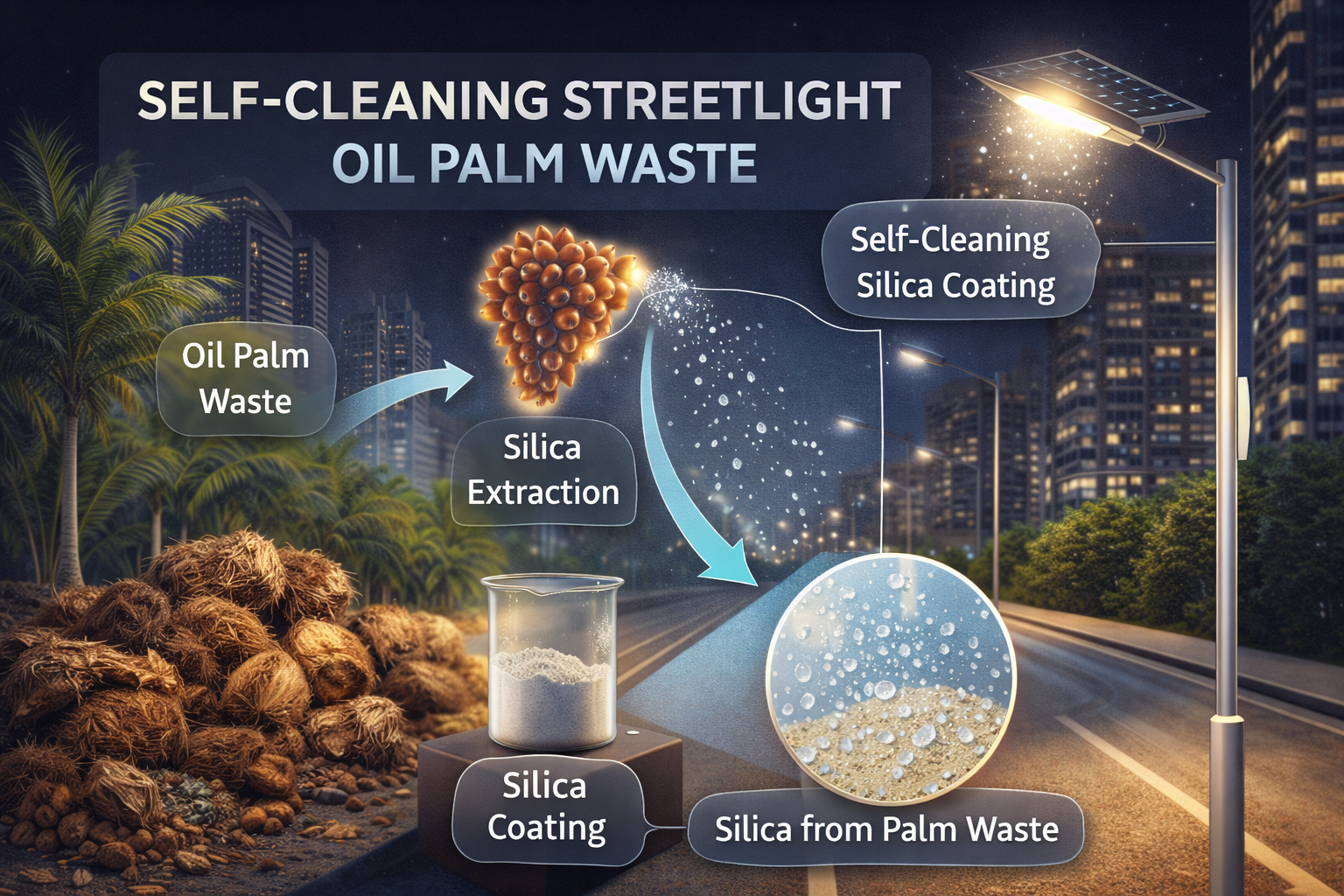
self cleaning streetlight oil palm waste
Introduction
Streetlights sit outside all year. Dust sticks to lenses. Soot builds up near roads. In humid areas, grime spreads fast. Cleaning crews cost money and time. That is why the idea of self cleaning streetlight oil palm waste is getting attention. It connects two big needs. Cities want cleaner lights with less upkeep. Palm regions want better ways to use waste. Instead of dumping palm waste, we can turn parts of it into helpful materials.
This guide explains the topic in plain English. You will learn what “self-cleaning” really means. You will learn how oil palm waste can become useful in coatings or parts. You will also learn what is proven in research, and what is still a “pilot idea.” For example, studies show silica can be extracted from empty palm fruit bunch ash and reach high purity after processing. We will keep it practical, safe, and easy to follow.
What “self-cleaning” means for a streetlight
A self-cleaning streetlight does not wash itself like a car wash. It uses smart surfaces or simple mechanisms. The goal is to keep the lens and solar panel clear. Clear surfaces help light spread better. Clear panels also charge better. Most “self-cleaning” designs use one of two methods.
The first is a special coating that changes how water behaves. Rain can sheet off and carry dirt away. The second is a tiny cleaning tool, like a wiper or brush, that runs on a schedule. In real science, self-cleaning coatings often use metal oxides like TiO₂. TiO₂ can break down some organic dirt under light.
Why oil palm waste fits this idea
Oil palm farming creates a lot of leftover biomass. Examples include empty fruit bunches, fibers, and ash after burning biomass for energy. Much of this ends up as waste. But some of it contains useful ingredients. One key ingredient is silica. Silica helps create rough micro surfaces, and rough surfaces can change wetting behavior. That matters for self-cleaning.
Research shows you can extract and characterize silica from empty palm fruit bunch ash. One study reports EPFB ash contains biogenic silica and can yield high purity silica after processing. There is also research using oil palm boiler ash in coating systems that show self-cleaning activity.
The two main self-cleaning coating styles
There are two main coating styles people talk about. One is super-hydrophilic coatings. These make water spread out like a sheet. The sheet can rinse dust and oily films. TiO₂/SiO₂ coatings are often used here. This style is good where it rains often or where condensation happens.
The other style is super-hydrophobic coatings. These make water bead up and roll off. Rolling drops can pick up loose dust like tiny balls. Super-hydrophobic coatings usually need a rough surface plus a low-energy surface treatment. Both styles can support self cleaning streetlight oil palm waste ideas.
How palm waste becomes coating “building blocks”
This part is simple. Palm waste is not applied raw to a streetlight. It must be processed into stable ingredients. A common pathway is ash → silica extraction → particle sizing → coating mix. A peer-reviewed study on EPFB ash reports silica concentration details and shows silica can be recovered and characterized with standard methods. Then the silica can be blended into a coating, often paired with TiO₂ for self-cleaning action under light.
Where the coating goes on a streetlight
A streetlight has a few surfaces that matter most. The first is the optical lens or cover. When it gets dirty, the light scatters and looks dim. The second is the reflector area on some fixtures. The third is the solar panel if the light is solar powered. Solar panels lose output when dust builds up.
A practical “system map” table
| Streetlight Part | Common Problem | Palm-Waste Role | Goal |
|---|---|---|---|
| Lens / cover | Dust, soot, oily film | Silica from palm ash for micro-roughness | Keep light output steady |
| Lens coating mix | Organic grime | TiO₂ for photocatalytic action | Reduce grime sticking |
| Solar panel | Dust lowers charging | Panel glass silica-based coating | Keep charging high |
| Housing | Dirt + weathering | Palm-waste fillers in paints | Reduce cleaning visits |
Benefits cities care about
City teams usually care about three things. First, brightness and safety. Clean lenses mean better light on the road. Second, cost. Fewer cleaning trips saves fuel, labor, and equipment. Third, sustainability. Using waste reduces landfill pressure and supports circular design.
Engineering challenges you must plan for
Self-cleaning coatings sound easy, but outdoor engineering is strict. The coating must not reduce transparency too much. It must survive UV light, heat, and rain. It must resist abrasion from wind-blown sand. It must also stick well to glass or polymer. Palm-waste silica adds another challenge: consistency. Waste sources can vary by mill, region, and burn conditions.
Safety, environment, and “greenwashing” risks
This topic can be done responsibly, but it can also be marketed badly. The word “waste” does not automatically mean “green.” You must look at the full chain. How is the waste collected? Does extraction use harsh chemicals? Is the final coating safe for runoff? These questions matter for real credibility.
How to pilot the idea in the real world
A strong pilot is small and measurable. Start with a short street segment. Use two groups of lights. One group has standard lenses. One group uses the new coating. Measure brightness on the ground, not just how it “looks.” Track cleaning time, cleaning cost, and lens haze over months.
FAQs
1) What is a self cleaning streetlight oil palm waste system?A self cleaning streetlight oil palm waste system is a streetlight that stays cleaner using smart surfaces or simple cleaning tools, using coating ingredients derived from palm waste, such as silica from ash.
2) Does self-cleaning mean no maintenance at all?No. It means less cleaning and more stable performance. Even the best coatings must be checked over time. Outdoor wear and scratches still happen.
3) How does TiO₂ help in self-cleaning coatings?TiO₂ can support photocatalytic action under light and can be part of super-hydrophilic self-cleaning films.
4) Can oil palm waste really become silica?Yes, research shows silica can be extracted and characterized from empty palm fruit bunch ash with proper processing.
5) Is this only useful in palm-growing countries?No. The materials may come from palm regions, but the problem is global. Dust, soot, and grime affect lighting everywhere.
6) What is the biggest risk in real deployment?Durability and optical clarity. If the coating reduces transparency or scratches easily, it can harm performance.
Conclusion
The big idea is simple: streetlights should stay brighter for longer with fewer cleaning visits. The self cleaning streetlight oil palm waste concept tries to solve this with smart coatings and circular materials. Scientific work supports key pieces of the puzzle. Studies show silica can be recovered from empty palm fruit bunch ash and reach high purity after processing. Research also describes TiO₂/SiO₂ coatings with self-cleaning behavior that fit outdoor and lens-type needs.
You may also like to read About: Barbara Boothe: BiographyAbout the Author